Need formwork engineering support for your next project? Talk to an Engineer

About Doka — Decades of Formwork Engineering

Founded in the 1960s, Doka has grown from a regional formwork supplier into a global engineering partner serving contractors in more than 70 countries. Our business is built on a straightforward premise: the right formwork, properly engineered and maintained, reduces risk and accelerates construction schedules.

1960s
Company Founded
70+
Countries Served
160+
Branch Offices
8,000+
Employees Worldwide
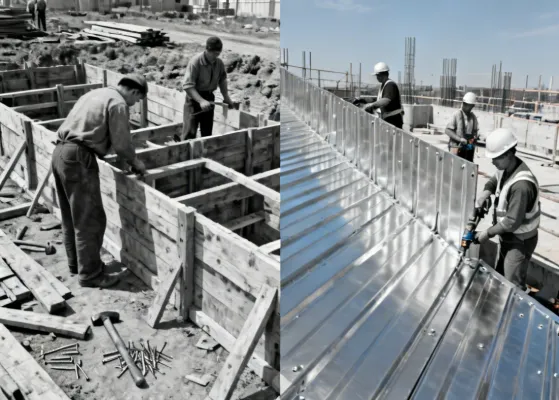
Evolution of formwork from timber to modern steel systems

From Timber Shutters to Engineered Systems

Doka began producing timber formwork components in Austria during the postwar construction boom. As concrete structures grew taller and more complex through the 1970s and 1980s, our engineers developed steel-frame panel systems that could be assembled, stripped, and reassembled hundreds of times without degradation in surface quality or dimensional accuracy.

Today, Doka's product range includes wall formwork, slab formwork, climbing platforms, load-bearing towers, and timber beams — supported by a network of depots that inspect, maintain, and ship formwork to job sites worldwide.

Our engineering teams do not simply supply panels. They produce project-specific forming plans, structural calculations, and assembly drawings that integrate with the contractor's rebar and concrete placement sequences. This pre-construction engineering is what separates a formwork system from a pile of steel panels.
Key Milestones

1960s

Company Founded

Doka established as a timber formwork producer in Austria, supplying local construction firms with shuttering panels and props.

1970s

Steel Frame Panel Development

Launched the first generation of steel-frame wall formwork panels, enabling higher concrete pressures and longer service life than timber shutters.

1980s

International Expansion

Opened branch offices across Europe and the Middle East, establishing the depot-based rental model that remains central to the business today.

1990s

Climbing System Launch

Introduced hydraulic self-climbing platforms for high-rise core construction, eliminating crane dependency for vertical form advancement.

2000s

Global Depot Network

Expanded to over 100 depots worldwide, providing localized inventory, engineering support, and on-site supervision services.

2020s

Digital Forming & Sustainability

Rolled out BIM-integrated forming plans and expanded the panel recertification program to track lifecycle carbon across the rental fleet.

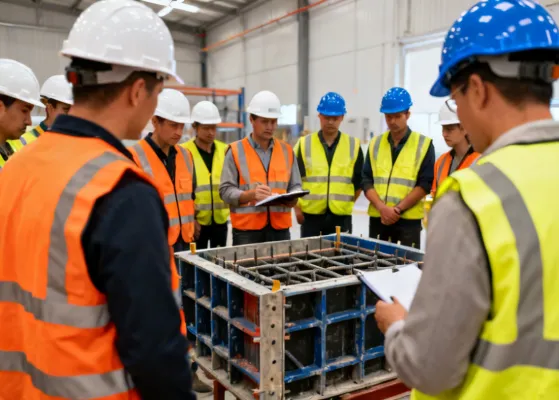
Doka safety training session for formwork assembly

Safety Is an Engineering Discipline

Formwork-related incidents on construction sites most often trace back to ad-hoc assembly decisions made under schedule pressure. Doka's approach treats safety as an engineering output: every forming plan includes explicit assembly sequences, lifting-point specifications, bracing requirements, and stripping procedures.

Our field supervisors verify the first assembly cycle against the approved drawings before the contractor takes over. Ongoing toolbox talks and site audits are available throughout the structural phase on projects that require them.

ISO 9001:2015 Quality Management
ISO 14001:2015 Environmental Management
OHSAS 18001 Occupational Safety
PEFC/FSC Timber Sourcing

Understanding Formwork Limitations

Engineered formwork systems deliver measurable advantages on the right projects, but they are not universally applicable. Transparency about constraints helps project teams make informed decisions during the planning phase.

Geometric Constraints

Standard steel panels are manufactured in fixed widths (0.25 m to 2.70 m) and heights (up to 3.30 m per lift). Highly irregular or organic geometries — such as freeform architectural shells or sculptural facades — may require custom-fabricated elements at additional cost and lead time, or may be better served by CNC-milled EPS liners or 3D-printed molds rather than panelized steel formwork.

Environmental Limits

Steel formwork panels perform reliably across a wide temperature range, but extreme conditions impose constraints. Below −20°C, concrete curing slows to the point where cycle-time assumptions break down, and heated enclosures may be required. Above 40°C ambient, accelerated setting can reduce the available pour window. Coastal and marine environments accelerate corrosion on steel components, increasing maintenance frequency between deployments.

Economic Threshold

The mobilization, engineering, and logistics costs of a panelized formwork system are typically recovered when the total forming area exceeds 200–300 m² or when at least 3–5 reuse cycles are achievable. Below this threshold — for example, a single basement wall pour or a one-off retaining structure — conventional timber formwork may offer a lower total cost despite higher labor intensity.

Access & Logistics

Gang-formed wall panels can weigh over 2,000 kg per assembly and require crane access for placement. Sites with restricted overhead clearance, limited laydown area, or no crane availability may need to use smaller manually handled panels (up to 95 kg each), which increases assembly labor. Remote sites with poor road access may face extended delivery windows of 6–10 weeks compared to the standard 2–6 week lead time from regional depots.

Work With a Formwork Partner That Understands Your Build

Whether you need engineering support for a single pour or a system rental covering an entire tower, our team is ready to scope and plan alongside you.

Contact Us See Our Projects